How Sound Therapy Can Improve Sleep
A Holistic, Non-Invasive Approach to Deep Rest
Sleep is not just rest—it is the foundation of physical health, emotional balance, and mental clarity. Yet in today’s fast-paced world, many people struggle to fall asleep, stay asleep, or wake up feeling restored.
Sound therapy offers a gentle, non-invasive way to support better sleep by working directly with the nervous system, the body’s stress response, and natural brain rhythms. Rather than forcing sleep, sound therapy helps create the internal conditions where sleep can occur naturally.
The connection between sound and the nervous system
Sleep begins in the nervous system.
When the body is in a state of stress or alertness, the nervous system remains in sympathetic mode (often called “fight or flight”). In this state, the mind stays active, muscles remain tense, and deep sleep becomes difficult.
Sound therapy helps shift the body into parasympathetic mode—the “rest and digest” state—by:
- Slowing the breath
- Reducing muscle tension
- Calming mental overactivity
- Signaling safety to the body
Low-frequency, harmonious sounds—such as those produced by singing bowls—are especially effective because they are felt not only through the ears, but also through the body as gentle vibration.
How sound therapy affects brain waves
Healthy sleep involves a natural progression of brain waves:
- Beta waves (alert, thinking)
- Alpha waves (relaxed awareness)
- Theta waves (deep relaxation, pre-sleep)
- Delta waves (deep, restorative sleep)
Sound therapy helps guide the brain from faster, active waves toward slower, sleep-supportive frequencies. Many people experience this as:
- Quieter thoughts
- A sense of drifting or floating
- Losing track of time
- Feeling “heavy” or deeply relaxed
This transition is especially helpful for people who struggle with racing thoughts at bedtime.
Why singing bowls are particularly supportive for sleep
Singing bowls produce complex, layered tones that gently surround the listener. Unlike sudden or stimulating sounds, these tones are:
- Continuous and predictable
- Low in sharp frequencies
- Naturally rhythmic
- Soothing to the nervous system
Because the sound is felt both internally and externally, the body often relaxes before the mind does. This is why sound therapy can be effective even for people who say, “I can’t turn my brain off.”
Sound therapy and emotional release before sleep
Unprocessed emotions are a common cause of sleep disturbances. Stress, grief, anxiety, or overstimulation can remain stored in the body, even when we are physically exhausted.
Sound therapy creates a safe, non-verbal space where the body can release emotional tension without needing to analyze or relive it. Clients often report:
- Feeling lighter after a session
- A sense of emotional settling
- Reduced nighttime anxiety
- Fewer stress-related awakenings
When emotional tension softens, the body can rest more deeply.
Supporting circadian rhythm and sleep consistency
Regular sound therapy sessions—especially in the evening—can help train the body to associate certain sounds with relaxation and rest. Over time, this can:
- Improve sleep onset
- Reduce nighttime awakenings
- Enhance sleep depth
- Support a more consistent sleep schedule
Even a short sound-based relaxation practice before bed can help signal to the body that it is time to slow down.
Who may benefit from sound therapy for sleep
Sound therapy can be especially supportive if you:
- Have difficulty falling asleep due to stress or anxiety
- Wake up frequently during the night
- Feel tired but mentally “wired”
- Experience sleep disruption during life transitions
- Want a non-medicated, non-invasive approach to better rest
Important note: Sound therapy is a supportive wellness practice and does not replace medical care. If you have chronic insomnia, sleep apnea, neurological conditions, sound sensitivity, or are pregnant, consult a healthcare provider and inform your practitioner so sessions can be adapted safely.
What a sound therapy session for sleep feels like
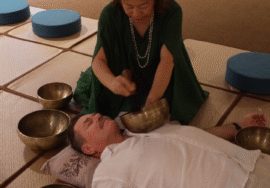
During a sleep-focused sound therapy session, you remain fully clothed and comfortably supported. The session is typically gentle, slower-paced, and lower in volume.
Many people experience:
- Deep relaxation within minutes
- Slowed breathing
- A quiet, spacious mind
- A feeling similar to “pre-sleep calm”
- Improved sleep the night of or following the session
Some clients even fall asleep during the session itself.
A gentle path back to rest
Sleep is not something we can force—it happens when the body feels safe enough to let go. Sound therapy works by restoring that sense of safety, rhythm, and ease.
Through gentle vibration and intentional sound, the body is reminded how to rest.
If you are seeking a holistic, non-invasive way to support better sleep, sound therapy may be a meaningful addition to your wellness routine.
Please call 949-787-5915
Private, tailored sound therapy sessions available.