Music Therapy and Singing Bowl Therapy: Different Approaches to Nervous System and Whole-Body Healing
Music therapy works primarily through the brain and nervous system, using sound as a structured stimulus to improve specific functions.
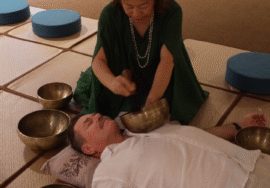
Singing bowl therapy works through vibration and resonance, creating a deeply regulating sound field that allows the entire mind–body system to return to balance.
1. Core Difference: Two Different Therapeutic Logics
Music Therapy
- Operates within a clinical, medical, and psychological framework
- Sound is treated as a stimulus
- The nervous system is the primary target
- Outcomes are defined in advance
Singing Bowl Therapy
- Operates within a mind–body–energy–spirit framework
- Sound is treated as a field and vibration
- The nervous system is one gateway, not the final target
- Outcomes are emergent and systemic
2. Corrected & Refined Comparison Table
Differences Between Music Therapy and Singing Bowl Therapy
| Dimension | Music Therapy | Your Singing Bowl Therapy |
|---|---|---|
| Core Paradigm | Bio-psycho-social medical model; part of clinical and rehabilitative medicine | Holistic mind–body–energy–spirit model; complementary and integrative healing |
| Primary Focus | Brain function, nervous system regulation, and observable behavior | Whole-system coherence: nervous system, body tissues, emotional field, and energy flow |
| Role of the Nervous System | Central target of intervention | One of several systems that naturally reorganize through vibration |
| Core Mechanism | Neuroscience-based: auditory processing, neuroplasticity, rhythm–motor coupling, emotional regulation | Vibration-based: physical resonance, fascial conduction, autonomic calming, and energetic harmonization |
| Treatment Method | Structured, goal-oriented techniques (rhythmic training, guided listening, improvisation) | Immersive vibrational sound fields using singing bowls and gongs |
| Client Engagement | Often active (listening, responding, moving, verbalizing) | Primarily receptive and experiential (lying down, sensing, allowing) |
| Verification of Effects | Evidence-based research, clinical scales, functional outcomes | Subjective experience, somatic awareness, emotional release, long-term self-regulation |
| Practitioner Role | Certified clinician applying therapeutic protocols | Facilitator and holder of a coherent vibrational field |
| Nature of Outcomes | Symptom reduction and functional improvement | State transformation, inner balance, and systemic harmony |
3. Differences in Action Pathways
Music Therapy: Top-down regulation
Sound → auditory system → brain processing → nervous system → behavior & emotion
- Requires cognitive and neural processing
- Works best when the brain is actively engaged
- Especially effective for rehabilitation, speech, motor control, trauma therapy
Singing Bowl Therapy: Bottom-up + field-based regulation
Vibration → body tissues & fascia → autonomic nervous system → emotional & energetic regulation
- Does not require understanding or active listening
- Works even in very deep, non-verbal states
- Explains why people can feel profound effects while “half asleep” or silent
4. Difference in Therapeutic Goals
Music therapy aims to change specific functions
- reduce anxiety scores
- improve speech clarity
- regulate mood or movement
- Your singing bowl therapy aims to restore systemic harmony
- emotional release
- deep calm and safety
- felt sense of flow, openness, and wholeness
One works on functions.
The other works on state.