Tuning Forks vs. Kasa Full Moon Bowls: Why Instrument Choice Matters in Sound Therapy
Sound therapy offers a wide range of tools, from tuning forks to gongs to singing bowls. Each has its own qualities, strengths, and limitations. Among these, tuning forks and handcrafted, seven-metal Kasa Full Moon Bowls are often compared—but they function in fundamentally different ways. Understanding the difference explains why instrument choice matters deeply for therapeutic resonance.
1. Precision vs. Immersion
Tuning forks are precise tools. Each fork produces a single, defined frequency designed to target a specific area of the body, an energetic point, or a nervous system response. They are excellent for pinpoint work, offering focused vibration and measurable resonance.
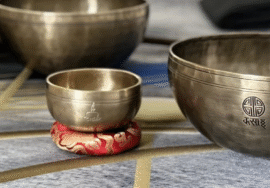
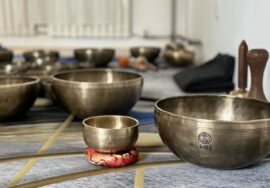
Kasa Full Moon Bowls, by contrast, produce layered, long-decaying harmonics. Their sound is not a single tone—it is a living spectrum of frequencies that moves through the body and environment simultaneously. This creates immersive resonance, engaging multiple tissues, fluids, and nervous system pathways at once.
In short: tuning forks instruct; Kasa bowls invite.
2. Interaction and Responsiveness
Tuning forks are linear and static. Once struck, they vibrate at a fixed frequency regardless of the listener’s state. The practitioner can direct it, but the fork does not respond to touch, energy, or pacing.
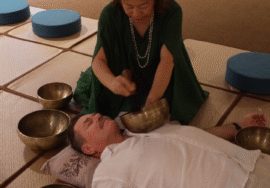
Kasa Full Moon Bowls are highly responsive instruments. The vibration adapts to the practitioner’s hands, the room’s acoustics, and the participant’s nervous system. They create a dynamic, co-regulated sound field, where the sound emerges from the interaction rather than being imposed.
3. Nervous System Engagement
Because tuning forks are precise, they work best when the nervous system is already prepared to receive correction or stimulation. For individuals who are stressed, fatigued, or hyper-vigilant, tuning forks can feel activating or focused, requiring conscious attention.
Kasa Full Moon Bowls, with their multi-layered harmonics and slow decay, allow the nervous system to follow the vibration at its own pace. The sound encourages softening, grounding, and integration without demanding effort, making them especially effective for immersive relaxation and systemic resonance.
4. Depth vs. Surface Effect
Tuning forks excel at delivering precise, targeted energy, but the depth is localized. They can activate a point, nerve pathway, or energetic center, but they do not engage the whole-body field in the same way.
Kasa Full Moon Bowls produce a field of vibration that flows through bones, fascia, fluids, and space, creating a full-body experience. This is why sessions with Kasa bowls often feel transformative, not just relaxing or stimulating.
5. Practical Implications
- Use tuning forks when the goal is pinpoint activation, neuromodulation, or targeted energetic work. They are precise, clinical, and effective for specific interventions.
- Use Kasa Full Moon Bowls when the goal is immersive, full-body resonance, nervous system regulation, emotional release, and presence-based integration. They are relational, adaptive, and holistic.
6. The Bottom Line
Both tools have value, but they serve different purposes. Tuning forks are like a scalpel—precise and focused. Kasa Full Moon Bowls are like a flowing river—layered, adaptive, and immersive.
For deep, whole-body resonance, nervous system regulation, and transformative sound experiences, Kasa Full Moon Bowls are unmatched. They do not just create sound; they create a living field of vibration that meets the body, mind, and environment in real time.