My Healing Philosophy: Why Depth Matters More Than Precision in Sound Work
There is a widespread belief that transformation comes from targeting the right frequency. That if you locate the exact vibration, tone, or note, the body will automatically correct itself.
This belief is appealing because it promises certainty. It suggests that the body is a mechanical system that only needs the right adjustment.
My experience tells a different story.
The body does not shift because it is corrected.
It shifts because it feels safe enough to reorganize.
This distinction sits at the core of my healing philosophy.
Frequency-focused tools—such as tuning forks and, in some cases, crystal bowls—are built around precision. They are designed to address specific points, pathways, or energetic concepts. Used skillfully, they can be effective. But they also carry an assumption: that the system receiving the sound is already stable enough to integrate it.
Many people are not.
Modern nervous systems are overstimulated, fatigued, and chronically vigilant. Bodies arrive carrying unprocessed stress, fragmented attention, and a constant background hum of urgency. In this state, precision does not always feel supportive. It can feel intrusive. Even well-intended direction can register as pressure.
What the system needs first is not instruction.
It needs containment, continuity, and permission to slow down.
This is where depth becomes essential.
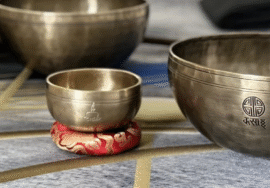
Kasa Full Moon Bowls offer depth not by targeting, but by surrounding. Their sound is not linear or directive. It unfolds in layers, spreads gradually, and lingers long enough for the body to meet it without effort. Rather than telling the system where to go, the sound creates a field in which the system can begin to listen to itself.
This invitation-based approach reflects how real change occurs. Nothing is forced. Nothing is corrected. The body is given time to settle, orient, and soften. From that place, reorganization happens naturally.
Crystal bowls often function ceremonially or aesthetically. Their clarity can be expansive and luminous, but for some bodies it is also activating. Tuning forks operate with clinical clarity, delivering precise information to specific areas. Kasa bowls sit between these worlds, yet lean firmly toward the somatic. They support the whole field—body, breath, attention, and environment—rather than isolating a single point.
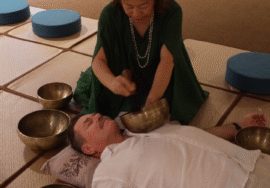
In my sessions, I am not trying to fix energy or adjust frequency. I am shaping conditions. I am listening to pace, observing response, and allowing sound to do what it does best: create space for the system to remember its own coherence.
Depth gives the body room.
Precision can come later—if it is needed at all.
This is why I choose depth over precision.
And presence over performance.
.