Why I Work With Kasa Full Moon Bowls: A Physiological Perspective on Sound Work
Sound work is not abstract to me.
It is not symbolic, decorative, or performative.
It is physiological.
The human system does not respond to intention alone. It responds to pressure, vibration, rhythm, timing, and resonance. Long before meaning is assigned, the body is already interpreting sound through skin, fluid, bone, and nerve pathways. This understanding is the foundation of why I work primarily with Kasa Full Moon Bowls, rather than crystal bowls or tuning forks.
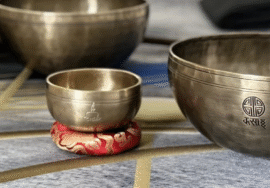
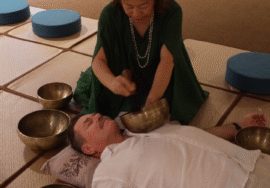
Kasa bowls are made from a bronze alloy that produces complex, layered harmonic fields rather than a single dominant tone. When activated, their sound does not sit on the surface of the body or remain confined to the ears. It travels through tissue, fluid, fascia, and skeletal structure. This matters because the body is not a hollow container—it is a conductive, hydrated system designed to transmit vibration.
Sound that moves through the body slowly and continuously allows the nervous system to orient without effort. Instead of drawing attention outward, the system begins to settle inward. Over time, breathing naturally deepens, muscular tension releases, and mental activity softens—not because this is instructed, but because the system recognizes a consistent, non-threatening rhythm.
From a physiological perspective, states of deep rest emerge when the nervous system is given time and continuity, not sudden stimulation. Kasa bowls support this because their sound decays gradually. There is no abrupt stop, no sharp edge, no demand for focus. The sound lingers long enough for the body to follow it down into slower, more spacious internal states.
Crystal bowls, while visually and sonically striking, often produce bright, singular frequencies with strong attack. For some systems, this clarity is uplifting. For others—especially those already carrying stress, vigilance, or sensory sensitivity—it can feel activating. Attention sharpens rather than softens. The body stays alert.
Tuning forks operate with even greater precision. They are designed to deliver exact vibratory input to specific locations. This can be useful, but it requires direct application and intentional engagement. The listener is asked to participate actively, to focus, to receive something specific. These tools function more as interventions than environments.
Kasa bowls work differently.
They create an immersive field. They do not ask the body to concentrate, adjust, or understand. The listener does not need to “do” anything. The system is free to respond in its own timing, in its own way. This passive receptivity is not passive in effect—it allows the body’s innate regulatory processes to come back online without interference.
From a physiological lens, this approach is not subtle. It is efficient. The body recognizes coherent vibration immediately. It responds before language, before thought, before belief.
This is why I choose Kasa Full Moon Bowls.
Not because they are louder or more dramatic, but because they work with the body as it actually is.
They speak the body’s language.