Why Machine-Made Bowls Are Not Suitable for Sound Therapy
Not all bowls are created equal. At first glance, a machine-made bowl might look similar to a handcrafted singing bowl, but the difference between a decorative bowl and a true sound therapy instrument is profound.
1. Material Purity and Resonance
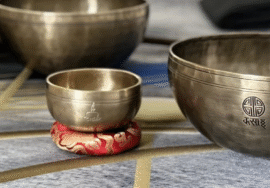
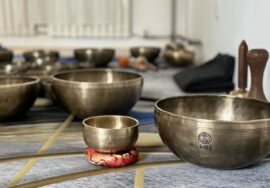
High-quality sound bowls, like Ultimate Kasa Full Moon Bowls, are crafted from a seven-metal alloy of the highest purity. This precise combination of metals creates layered harmonics, long-decay resonance, and complex vibrations that travel through air, bone, fascia, and fluids.
Machine-made bowls, by contrast, are often cast cheaply, with uneven alloys or impure metals. Their sound is flat, short-lived, or dissonant. They may ring for a moment, but the vibration dies quickly, and the body cannot fully absorb it. The resonance needed to create a therapeutic effect simply isn’t there.
2. Handcrafting Creates a Responsive Instrument
Every handcrafted bowl is shaped, hammered, and tuned individually, giving it a unique behavior. When played, the sound responds to touch, pressure, pacing, and breath, creating a dynamic interaction between practitioner and instrument.
Machine-made bowls are uniform and rigid. They do not respond to subtle variations in touch. Strike them harder, slower, or softer, and they barely change. There is no dialogue, no co-regulation, no adaptive resonance. In short, they are static, not living instruments.
3. Vibrations That Reach the Whole Body
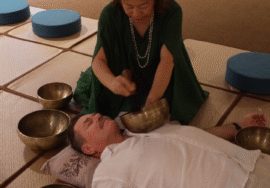
Sound therapy depends on multi-layered vibrations that travel through the entire body. Handcrafted bowls produce rich overtones and sustained decay, allowing the nervous system to follow the vibration, soften, and integrate it.
Machine-made bowls are often thin, uneven, or inconsistent, producing a sharp or metallic tone that activates attention rather than relaxes. They may sound pleasant on the surface, but they do not create the deep, whole-body experience necessary for true sound work.
4. Depth vs. Decoration
A machine-made bowl may be beautiful to look at and even “sing” briefly, but it cannot hold the space for nervous system regulation. It is decorative, ceremonial, or aesthetic, not therapeutic. True sound therapy is relational—it relies on the interaction between practitioner, instrument, body, and environment. A bowl that cannot respond dynamically cannot participate in that relational field.
5. Why Choice Matters
The quality and craftsmanship of the instrument directly affect the effectiveness of sound therapy. High-purity, handcrafted Kasa Full Moon Bowls create a living resonance field that allows the body to soften, the mind to quiet, and the nervous system to settle. Machine-made bowls cannot do this—they are visually appealing, but physiologically and energetically, they lack the depth, presence, and harmonic integrity necessary for true sound work.
In short, machine-made bowls are decorative; handcrafted, high-purity bowls are therapeutic. One produces surface sound for the eyes, the other produces multi-layered resonance that the body, mind, and nervous system can fully receive.