With So Many Therapeutic Machines, Why Do We Still Need Sound Therapy?
Modern life offers an endless array of therapeutic machines—massage chairs, biofeedback devices, light therapy tools, vibration plates, neurostimulation devices, and more. Each promises relief, optimization, or transformation. Yet, despite these technological solutions, sound therapy remains uniquely valuable.
1. Sound Works With the Whole Body, Not Just Parts
Many machines target specific systems or isolated areas: muscles, circulation, brain waves, or skin. Sound therapy, in contrast, works holistically. Vibration travels through bones, fascia, fluids, and organs simultaneously, engaging the body as an integrated system. It doesn’t just act on one part; it resonates with the nervous system, the breath, the posture, and the subtle rhythms of the body at once.
This means sound can create coherence across multiple layers of experience—physical, emotional, and nervous system—without requiring external manipulation or intervention.
2. Sound Is Relational, Not Just Mechanical
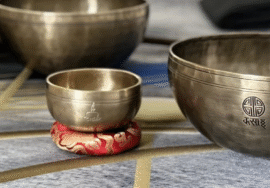
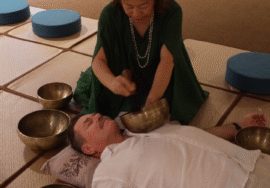
Machines deliver input. They apply force, frequency, or light, but the body is largely passive. Sound therapy is interactive by nature. The vibration responds to the body’s tissues, the practitioner’s hands, the room, and the listener’s presence. With high-purity seven-metal Kasa Full Moon Bowls, each tone is a dialogue, not a command. The practitioner and participant co-create the experience, which allows the body to receive, integrate, and self-regulate naturally.
Machines are programmed to follow a protocol. Sound, in contrast, adapts in real time to the living system. It is subtle, relational, and responsive.
3. Nervous System and Emotional Resonance
Most machines operate at a physical or neurological level but rarely address the emotional and regulatory dimensions of the nervous system. Sound moves through the body in ways that speak directly to the parasympathetic system, encouraging relaxation, safety, and embodied awareness. It provides an environment in which the body can release tension, reorganize rhythms, and experience presence.
No machine can replicate the way layered, long-decaying harmonics from Kasa Full Moon Bowls are perceived by the entire system at once. The sound is felt, heard, and integrated—a multi-sensory, relational experience.
4. Accessibility and Non-Demanding Nature
Therapeutic machines often require correct positioning, learning, and active engagement. Sound therapy requires nothing. Participants do not need to think, focus, or act. They simply receive vibration and resonance. This simplicity is transformative in itself, because it allows the nervous system to let go rather than comply.
5. Presence and Depth Beyond Technology
Machines are precise, reproducible, and mechanical. Sound therapy is organic, immersive, and presence-driven. It invites not just relaxation, but awareness, emotional release, and a sense of connection—to the body, to space, and to the practitioner. It works where technology cannot: in subtlety, depth, and resonance.
6. Why We Still Need Sound
Even in a world full of machines, sound therapy fills a gap machines cannot reach. It is holistic, relational, adaptable, and immersive. It supports the nervous system, encourages embodied awareness, and creates conditions for deep relaxation and integration.
High-purity, seven-metal Kasa Full Moon Bowls exemplify this power. Their complex harmonics travel through the body and space, responding in real time to the listener and practitioner. They create an experience no machine can reproduce—a living field of resonance that the body feels and integrates on its own terms.
In a world of technology, sound therapy reminds us that vibration, resonance, and presence are irreplaceable tools for the body, mind, and nervous system.