Why I Do Not Work With Tuning Forks — and Why I Choose Ultimate Kasa Full Moon Bowls Instead
People often ask why I do not use tuning forks, or why I do not combine crystal bowls with tuning forks in my work. The assumption is that more tools, more precision, or more techniques must lead to deeper results.
My experience has shown the opposite.
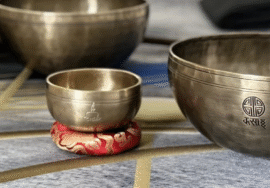
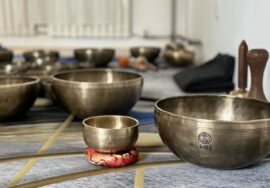
I work exclusively with Ultimate Kasa Full Moon Bowls, which are crafted from a seven-metal alloy of the highest grade of purity. This material choice is not symbolic to me—it is functional. The purity and composition of the alloy directly affect how sound travels, layers, and sustains within the body and the surrounding space.
Tuning forks are designed for precision. They deliver a single, fixed vibration to a specific location. This can be useful in contexts that call for targeted input, but it requires direct application, focused attention, and an active receiving posture. The listener is often asked to track sensation or hold awareness on a point.
For many modern nervous systems, this is already familiar territory. Daily life demands constant focus, correction, and responsiveness. When a system is already vigilant, additional precision can feel like more instruction rather than relief. The body may comply, but it does not necessarily soften.
Kasa Full Moon Bowls operate on an entirely different principle.
They do not direct the body.
They create an environment.
The seven-metal alloy, when forged and refined at high purity, produces complex, multi-layered harmonic resonance rather than a single dominant tone. When played, the sound unfolds slowly and evenly. It surrounds the body, moves through it, and lingers long enough for the system to respond without effort.
This matters.
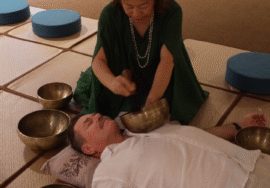
Instead of narrowing attention to a point, Kasa bowls broaden the sensory field. The listener is not asked to focus, analyze, or participate actively. The body is free to respond through breath, sensation, and internal rhythm—its own language.
Crystal bowls, while visually striking and sonically clear, tend to project sound outward with brightness and immediacy. Their clarity can uplift mood and sharpen awareness, but it can also keep the system subtly alert. The sound is often experienced as something to listen to, rather than something to rest within.
Tuning forks intensify this effect by design. They emphasize accuracy and direction. They narrow the experience.
Kasa bowls do the opposite.
The resonance created by a high-purity, seven-metal alloy does not stop abruptly. It decays slowly, allowing the body time to follow the sound into stillness. This continuity supports depth—not because anything is being adjusted, but because nothing is being demanded.
Another reason I do not rely on tuning forks is that Kasa bowls require regulation from the practitioner. They cannot be rushed or forced. If my pacing is off, the sound collapses. If my internal state is unsettled, the bowl reflects it immediately. The instrument does not compensate for force, distraction, or excess.
This keeps the work honest.
The effectiveness of Kasa Full Moon Bowls is not only about the object itself. It arises from the relationship between practitioner, instrument, client, and environment. The hands, the metal, the room, and the body receiving the sound form a single field of resonance.
This is why I do not layer tools unnecessarily.
More tools do not create more depth.
More precision does not guarantee more impact.
Depth comes from coherence.
From continuity.
From sound that allows the body to stop monitoring and start listening.
That is what Ultimate Kasa Full Moon Bowls—crafted from a seven-metal alloy of the highest purity—make possible.
And that is why I choose them.